

Analysis Of The Technical Features Of Smart Mirrors
Nov 29, 2025
Leave a message
As a new type of interface terminal in modern smart living, smart mirrors are characterized by deep integration and synergistic optimization across multiple dimensions, including optical performance, display integration, sensor interaction, structural protection, and system linkage. Compared to traditional mirrors, smart mirrors break through the limitations of a single reflective function. Through the systematic application of interdisciplinary technologies, they achieve comprehensive capabilities in information visualization, environmental perception, and multi-device collaboration, bringing significant experience enhancements and application value to home and commercial scenarios.
In terms of optical performance, smart mirrors rely on high-quality substrates and precision reflective films to construct a clear mirror image. Ultra-white float glass or low-iron glass is commonly used as the substrate, possessing high light transmittance and low dispersion characteristics, ensuring that the reflected image has no color shift and sharp details. The back is coated with a high-reflectivity metal film such as silver or aluminum through a vacuum evaporation process, forming a uniform and dense optical reflective surface, ensuring the brightness and stability of the mirror image. Some products incorporate electrochromic or polymer-dispersed liquid crystal (PDLC) films, enabling rapid switching between transparent and frosted states under electric field control. This provides the physical basis for the superposition or separation of displayed information and the mirror image, while maintaining high optical consistency during the switching process without affecting reflection quality.
Display and touch integration is one of the core technological features of smart mirrors. They utilize high-resolution LCD or OLED display panels, combined with thin-film transistor matrix driving, to achieve real-time rendering of text, images, and videos. To maintain spatial consistency between the mirror image and the displayed content, the panel and reflective substrate must undergo high-precision optical alignment and dust-free bonding to eliminate parallax and ghosting. Touch functionality is achieved through ITO conductive films or capacitive sensor arrays, providing multi-touch and gesture recognition capabilities with sensitive response and precise positioning. Anti-glare and anti-fingerprint surface treatments further optimize visibility and tactile feedback under different lighting conditions.
Sensing and interaction technologies are key supports for the intelligentization of smart mirrors. Built-in light sensors dynamically adjust display brightness, balancing visual comfort and energy consumption; temperature and humidity sensors monitor environmental conditions, providing data for health alerts or environmental linkages; human proximity sensors intelligently wake or put the device into sleep mode, optimizing user experience and energy utilization. High-end models are equipped with microphone arrays and voice recognition modules, supporting natural language command input for contactless operation. Data from these sensors is processed through analog-to-digital conversion and fusion algorithms, enabling the device to possess contextual awareness and autonomous response capabilities.
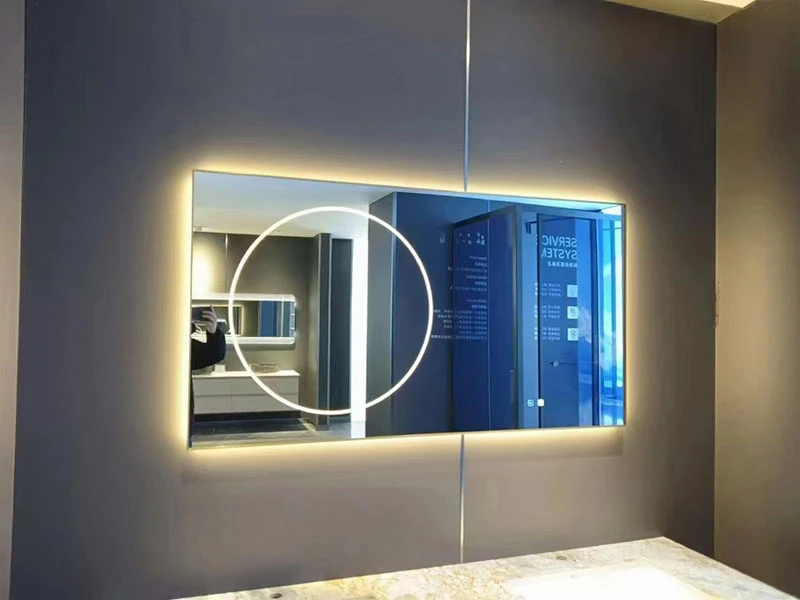
Structural protection technology ensures stable operation of the smart mirror in complex environments. The frame is primarily made of lightweight, high-strength aluminum alloy or stainless steel, precision-machined by CNC and surface anodized or sandblasted, providing both mechanical protection and aesthetic appeal. Internal electronic components are protected by a three-proof coating, waterproof gaskets, and sealed cavity design, creating a moisture-proof, dust-proof, and corrosion-resistant sealed environment to meet the stringent requirements of high-humidity environments such as bathrooms. The heat dissipation structure is optimized based on heat source distribution, combined with thermally conductive materials and convection channel design, ensuring thermal stability and reliable performance during long-term operation.
System linkage and communication capabilities demonstrate the openness and scalability of the smart mirror. The main control chip integrates wireless communication modules such as Wi-Fi, Bluetooth, and Zigbee, enabling seamless connection to smart home hubs or mobile terminals. This allows for the push of cloud-based information such as time, weather, and news, as well as contextualized control of devices like lights, air conditioners, and curtains. An embedded operating system handles task scheduling, interface management, and security encryption, ensuring stable data interaction and user privacy protection. The modular hardware and software design supports feature customization and future upgrades, enhancing the adaptability and lifecycle of the solution.
Overall, the smart mirror's technical characteristics lie in its high-quality optical reflection as a foundation, integrating high-precision display and sensitive touch, multi-dimensional sensing and intelligent interaction, robust protection and efficient heat dissipation, as well as open communication and system collaboration. This creates a comprehensive terminal that combines mirror fidelity, information presentation, environmental awareness, and multi-terminal linkage capabilities. The integrated application of these technological advantages not only reshapes the functional boundaries of mirrors but also provides a more intuitive, convenient, and user-friendly interactive entry point for smart homes and commercial spaces.